Tuesday, September 20, 2005

"Nightboat" by Simon Le Bon and The Smashing Pumpkins


Version of Duran Duran's "Nightboat" by The Smashing Pumpkins. Simon Le Bon as the guest singer. Nightboat has been one of my favorite Duran Duran songs, and I like this version even more. Many thanks to DuranDuran.com message board, where I found this clip from :)

Monday, September 19, 2005

Just keeping track.. [9] (Matamata.com, The Jakarta Post)


Several photos of the exhibition have been uploaded by Pathindan here (many thanks :D).

Motulz put up a some photos about the exhibition here and Peter's last night in Jakarta here.


And here's another article from Matamata.com (Thanks, Tul!)


Peter van Dongen dan Rekan Pembuat Komik Indonesia


Mendengar nama Erasmus Huis alias pusat kebudayaan Belanda terasa betul aroma seriusnya. Yang tertanam dalam benak kalau bukan konser musik klasik pasti pameran lukisan yang bikin jidat mengkerut. Namun sepanjang bulan September ini kesan itu seolah sirna. Pasalnya, ada pameran yang bikin lidah berdecak lantaran tidak biasa-biasanya. Wah pameran apa ya?

Pameran yang dimaksud bertajuk “Peter van Dongen dan Rekan Pembuat Komik Indonesia” berlangsung antara tanggal 7-30 September 2005. Peter adalah penggambar komik asal Belanda dengan setting khas Indonesia. Komik Rampokan: Jawa racikan van Dongen berkisah tentang perjuangan kemerdekaan Indonesia, yang nota bene menjadi tanah leluhurnya. Buku ini diterbitkan di negeri keju pada tahun 1998 dan mendapat penghargaan Stripschappening untuk Buku Komik Terbaik tahun 1999 serta penghargaan Prix du Lion 1999 di Brussel.

Hajat ini sendiri digelar menandai perayaan 60 tahun kemerdekaan RI sekaligus diterbitkannya komik Rampokan: Jawa edisi bahasa Indonesia. Kemudian empat komikus lokal juga turut memamerkan karyanya di ajang ini. Mereka tergolong generasi muda dalam ranah komik lokal yang muncul di era 1990-an, masing-masing adalah Dwi Santoso alias Anto “Kapten Bandung” Motulz, Dwinita Larasati alias Tita, Muhammad Cahya Daulay alias Cahya dan Beng Rahadian alias Beng.

Ada puluhan item yang dipamerkan di tempat ini dan semuanya dipigura dengan manis. Karya-karya Peter yang tampak berupa artwork, salah duanya adalah versi asli Rampokan Jawa dan Rampokan Celebes. Bahkan dipajang pula halaman yang tampak masih tersisa coretan pinsil bahkan juga tipp-exnya. Versi surat kabar PS yang memuat komik Peter juga turut terpajang di dinding.

Sedangkan karya komikus lokal tampak pigura cover komik Kapten Bandung dari Motul bertajuk Kasus Tikus Tarka. Aroma kota Bandung terasa betul di sana, bukan hanya lewat penampakan angkot rute 03 jurusan Abdul Muis-Dago, melainkan istilah Tarka itu sendiri. Kependekan dari Taruna Karya ini adalah istilah khas di kota kembang yang berarti institusi kegiatan semacam Karang Taruna. Karya lain yang terhitung inovatif adalah coretan kartun dari Tita. Karya kandidat doktor ini malah cenderung lebih mirip catatan harian.

Pigura yang berisi halaman coretan Cahya lebih condong dengan gambar arsiran hitam putih. Cerita yang digelontorkanpun cenderung serius tidak seperti ketiga mitra lokalnya. Terakhir ada nama Beng yang cukup familiar di media massa. Di Koran Tempo ia kerap hadir menggambar komik. Pun di majalah komik lokal macam Wizard, sentuhan sosok kartunnya yang jenaka terasa akrab di mata.

Kalau ingin yang segar-segar, tak ada salahnya melangkahkan kaki ke Erasmus Huis. Kumpulan coretan yang menyejukkan itu dijamin bisa menjadi pelepas kepenatan, bahkan bagi mereka yang tak suka komik sama sekali. (bat)


From The Jakarta Post, 23 September 2005

Comic strips shed light on Indonesia's colonial past
M. Taufiqurrahman, The Jakarta Post, Jakarta

Despite his Indonesian roots, Dutch artist Peter van Dongen, 39, never spent a great deal of his time in this country and his work of art, an award-winning comic strip, was based solely on secondary sources such as old photos, soldiers' diaries and novels.

Yet, his best-known comic books Rampokan Java and Rampokan Celebes, two fictional stories about life in post-Independence Indonesia, contain breathtaking detail about daily attributes of the period, including people's daily clothing and their motifs, means of transportation, buildings and roadside advertisements.

Should the cartoon characters be erased from each panel, what would be left would be a realistic postcard view of cities in Java and Sulawesi, circa the 1940s.

Van Dongen uses a style that often features strong colors and a combination of cartoonish characters against a realistic background, a method he adopted from Belgian comic writer and artist Georges Remi, better known as Hergé, the creator of the renowned comic strip Adventures of Tintin.

In one panel from his comic Rampokan Java currently on display at the Dutch cultural center Erasmus Huis, which depicts Kota railway station, West Jakarta, viewers will be enraptured to find a true-to-life scene of a structure that still exists.

Van Dongen has meticulously used the sturdy, majestic dome-shaped construction as the perfect setting for bustling traffic comprising passing military trucks, a vintage sedan, becak (pedicabs), street hawkers and bystanders.

Another panel, showing busy life in Surabaya's Chinatown, is another example of Van Dongen's devotion to verit‚-style imaging.

Each detail, from the figure of an old Chinese man in a plain white suit, a small crowd that throngs a street vendor selling traditional drinks to the roadside advertisement, is given equal treatment, and none stands out above the others.

In doing so, Van Dongen adheres to another technique used by Hergé, ligne claire, which uses clear, strong lines with the same thickness and importance, rather than using them to emphasize certain objects or as shading.

The method is sometimes also called the "democracy of lines".

Van Dongen's commitment to geographical and cultural accuracy was inspired by Hergé's monumental work, The Blue Lotus, which tells the story of Tintin's adventure in China.

Hergé meticulously researched his subjects prior to making the Blue Lotus, to a point where he befriended a Chinese student, Zhang Chongren, who introduced the Belgium artist to Chinese history, culture and the arts.

The plot of Rampokan Java and Rampokan Celebes revolves around protagonist Johan Knevel's struggle to confront his inner demons.

Knevel, an Indonesian-born Dutch soldier, was sent back to the country as part of a battalion that would once again occupy the newly liberated Indonesia.

Knevel deserted his company after killing his soldier friend and assumed a new identity before going on an odyssey to revisit his long-lost past.

Rampokan Java was copublished by Joost Swarte and earned both author and publisher the 1999 Dutch Prize for Best Book Design.

Van Dongen, whose mother was a Chinese-Indonesian who once lived in Makassar and Manado, visited a number of Indonesian museums to collect background material for Rampokan.

in box: Peter van Dongen and the new generation of Indonesian cartoonists exhibition runs through Sept. 30 Erasmus Huis Jl. H.R. Rasuna Said Kav. S-3. tel. 5250507 website www.erasmushuis.or.id
(I don't have any access to whatever image is in the "in box", though)

Sunday, September 18, 2005

Tentang 'Graphic Novel' (Eddie Campbell's revised manifesto)


Hari ini, dari jurnal Neil Gaiman, ada link ke wawancara dengan Eddie Campbell (yg bersama Alan Moore membuat From Hell). Salah satu hal yang menarik dari wawancara adalah definisi Campbell mengenai istilah graphic novel, yg kesepuluh manifestonya dijabarkan di situs yang sama (saya kopi di bawah ini).

Membaca point2 manifesto itu benar2 mengingatkan pada beberapa posting di sebuah milis komunitas komik. Salah satunya, seseorang berujar, "Saya sedang membuat komik nih. Harus berapa halaman ya supaya bisa jadi graphic novel?"
Ah. Apakah benar panjang-pendeknya sebuah kisah bergambar menentukan 'pangkat'nya sebagai graphic novel atau bukan? Bagaimana bila dipaksa2 menjadi panjang, tapi cerita jadi bertele2, hingga membosankan? Lihat A Contract with God-nya Will Eisner, toh itu kumpulan cerita2 pendek? Atau dipaksa2 dipepet2 seirit mungkin, hingga banyak penggalan cerita yang hilang? Andaikan seri Sandman-nya Neil Gaiman dipaksakan hanya jadi 5 buku, apakah bisa dinikmati?
Jumlah halaman tidak bisa dijadikan patokan. Menurut point kedua, hal ini dapat mengakibatkan orang berpikir bahwa graphic novel hanyalah bentuk ilustrasi dari literatur biasa, padahal para pembuatnya memiliki cita2 lebih, yaitu membentuk karya rupa yg tidak terikat baik oleh aturan2 yang sudah ada, maupun yang baru.

Graphic novel mengambil bentuk dasar dari komik (yang dianggap memalukan), dan mengangkatnya ke tingkat yang lebih berambisi dan bermakna. Hal ini mengakibatkan berubahnya dimensi fisik si buku, hingga mungkin hasil akhirnya tidak lagi menyerupai 'buku komik'. Hal ini tidak menjadi soal. Yang patut dipertanyakan hanyalah, apakah hasil akhirnya menyumbangkan sesuatu ke pemikiran2 manusiawi.
Hal ini mengingatkan saya akan kata2 Will Eisner mengenai membuat komik, "Yang penting adalah, ada sesuatu yang hendak kau sampaikan". 'Sesuatu yg hendak disampaikan' di sini tidak hanya terbatas sebagai 'pesan moral' seperti yg kita dapat di akhir dongeng anak2, namun apa pun curahan hati, ide dan pikiran si pembuat komik. Ya, tanpa itu, komiknya hanya akan 'kosong' saja, tak berisi apa2 selain urutan gambar2 dan adegan2 aksi.

Salah satu point Campbell juga menyatakan bahwa para pembuat graphic novel tidak akan menyebut karya mereka sendiri sebagai "graphic novel" di antara rekan2nya. Istilah tersebut hanyalah dipakai utk, misalkan, mendefinisikan penempatan buku2 tsb pada rak di toko-toko buku yang belum akrab dengan bentuk/isi buku tsb. Membaca bagian ini, sempat membuat saya tersenyum sendiri, terutama pada kalimat penutupnya: "Furthermore, graphic novelists are well aware that the next wave of cartoonists will choose to work in the smallest possible forms and will ridicule us all for our pomposity".
Benar, bahwa kita mestinya harus kritis terhadap karya sendiri dan tidak cepat puas dengan menyebutnya "graphic novel" dengan berbangga hati. Biarlah para pembaca yang menilai, mengapresiasi dan menentukan hal tersebut. Memberi label pada karya sendiri sering berakibat pembatasan diri, atau penentuan (tingginya) standar yang bisa2 menghalang proses berkreasi. Sekali lagi, menurut saya, berkarya dan berkaryalah terus - bahwa karya2 tsb diterima sebagai bentuk seni berkualitas atau bukan, akan dibuktikan oleh apresiasi masyarakat.

Sebagai penutup entry kali ini, saya kutipkan salah satu kutipan dari wawancara tsb, mengenai konsep "komik":
"I have felt that the concept of what comics is gets narrower as we go along. Each writer on the subject who defines comics wants to exclude something. McCloud excludes the single panel so Family Circus and Far Side are out. Blackbeard says there must be word balloons so Prince Valiant is out. Harvey says there has to be a visual-verbal balance. Somebody else says there must be no redundancy of information with words and pictures repeating each other. This is crap. Pictures have illustrated words and words have explained pictures since the beginning of time. Somebody reads a dull comic and extrapolates rules from it. Who do they think they are? There are all these people trying to be the rule-makers and the end result is bad for the art of Comics. Fuck 'em all, that's what I say."

Berikut ini adalah kopian dari manifesto Campbell, dan link menuju ke situs wawancara selengkapnya: excerpt from In Depth: The Eddie Campbell Interview by Milo George

Eddie Campbell's (Revised) Graphic Novel Manifesto

There is so much disagreement (among ourselves) and misunderstanding (on the part of the public) around the subject of the graphic novel that it's high time a set of principles were laid down.

1. "Graphic novel" is a disagreeable term, but we will use it anyway on the understanding that graphic does not mean anything to do with graphics and that novel does not mean anything to do with novels. (In the same way that "Impressionism" is not really an applicable term; in fact it was first used as an insult and then adopted in a spirit of defiance.)

2. Since we are not in any way referring to the traditional literary novel, we do not hold that the graphic novel should be of the supposed same dimensions or physical weight. Thus subsidiary terms such as "novella" and "novelette" are of no use here and will only serve to confuse onlookers as to our goal (see below), causing them to think we are creating an illustrated version of standard literature when in fact we have bigger fish to fry; that is, we are forging a whole new art which will not be bound by the arbitrary rules of an old one.

3. "Graphic novel" signifies a movement rather than a form. Thus we may refer to "antecedents" of the graphic novel, such as Lynd Ward's woodcut novels but we are not interested in applying the name retroactively.

4. While the graphic novelist regards his various antecedents as geniuses and prophets without whose work he could not have envisioned his own, he does not want to be obliged to stand in line behind William Hogarth's Rake's Progress every time he obtains a piece of publicity for himself or the art in general.

5. Since the term signifies a movement, or an ongoing event, rather than a form, there is nothing to be gained by defining it or "measuring" it. It is approximately thirty years old, though the concept and name had been bandied about for at least ten years earlier. As it is still growing it will in all probability have changed its nature by this time next year.

6. The goal of the graphic novelist is to take the form of the comic book, which has become an embarrassment, and raise it to a more ambitious and meaningful level. This normally involves expanding its size, but we should avoid getting into arguments about permissible size. If an artist offers a set of short stories as his new graphic novel, (as Eisner did with A Contract with God) we should not descend to quibbling. We should only ask whether his new graphic novel is a good or bad set of short stories. If he or she uses characters that appear in another place, such as Jimmy Corrigan's various appearances outside of the core book, or Gilbert Hernandez' etc. or even characters that we do not want to allow into our "secret society," we shall not dismiss them on this account. If his book no longer looks anything like comic books we should not quibble as to that either. We should only ask whether it increases the sum total of human wisdom.

7. The term graphic novel shall not be taken to indicate a trade format (such as "trade paperback" or "hardcover" or "prestige format"). It can be in unpublished manuscript form, or serialized in parts. The important thing is the intent, even if the intent arrives after the original publication.

8. The graphic novelists' subject is all of existence, including their own life. He or she disdains "genre fiction" and all its ugly clichés, though they try to keep an open mind. They are particularly resentful of the notion, still prevalent in many places, and not without reason, that the comic book is a sub-genre of science fiction or heroic fantasy.

9. Graphic novelists would never think of using the term graphic novel when speaking among their fellows. They would normally just refer to their "latest book" or their "work in progress" or "that old potboiler" or even "comic" etc. The term is to be used as an emblem or an old flag that is brought out for the call to battle or when mumbling an enquiry as to the location of a certain section in an unfamiliar bookstore. Publishers may use the term over and over until it means even less than the nothing it means already.

Furthermore, graphic novelists are well aware that the next wave of cartoonists will choose to work in the smallest possible forms and will ridicule us all for our pomposity.

10. The graphic novelist reserves the right to deny any or all of the above if it means a quick sale.


Picture: Detail from The Fate of The Artist (C)2004 Eddie Campbell


Just keeping track.. [8] (Cek & Ricek, Tempo Magazine)


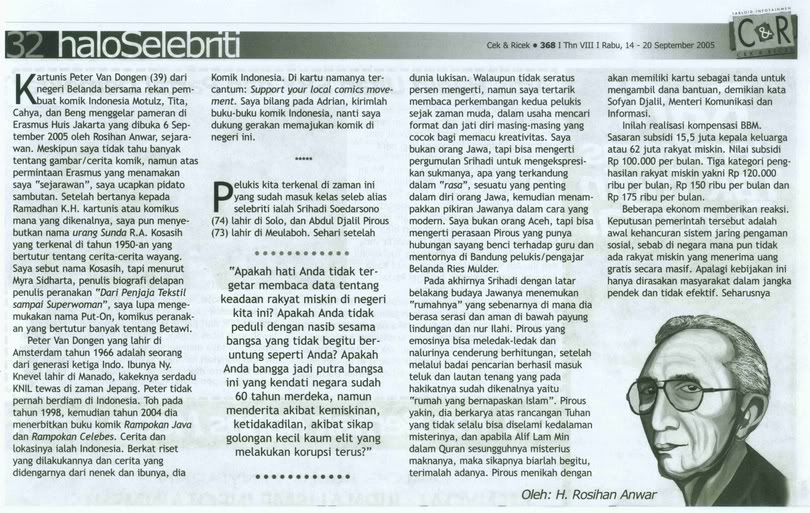
Cek & Ricek is a national gossip magazine in Indonesia (after having been a popular television program, at first). Rosihan Anwar, a senior journalist who opened the exhibition at Erasmus Huis wrote a short article about that event, followed by two other subjects in the "Halo Selebriti" column. Herewith I copied the contents of the article (only the one about the exhibition). Thanks to Rieza at Komik Alternatif mailing list for sending me scanned pages of the magazine :D

Cek & Ricek 14-20 September 2005
Pameran Komik Belanda Indonesia, Pelukis Srihadi Dan Pirous, Banggakah Anda Jadi Putra Bangsa Ini?
Oleh: H. Rosihan Anwar

Kartunis Peter Van Dongen (39) dari negeri Belanda bersama rekan pembuat komik Indonesia Motulz, Tita, Cahya dan Beng menggelar pameran di Erasmus Huis Jakarta yang dibuka 6 September 2005 oleh Rosihan Anwar, sejarawan. Meskipun saya tidak tahu banyak tentang gambar/cerita komik, namun atas permintaan Erasmus yang menamakan saya "sejarawan", saya ucapkan pidato sambutan. Setelah bertanya kepada Ramadhan K.H. kartunis atau komikus mana yang dikenalnya, saya pun menyebutkan nama urang Sunda R.A. Kosasih yang terkenal di tahun 1950-an yang bertutur tentang cerita-cerita wayang. Saya sebut nama Kosasih, tapi menurut Myra Sidharta, penulis biografi delapan penulis peranakan "Dari Penjaja Tekstil sampai Superwoman", saya lupa mengemukakan nama Put-On, komikus peranakan yang bertutur banyak tentang Betawi.
Peter Van Dongen yang lahir di Amsterdam tahun 1966 adalah seorang dari generasi ketiga Indo. Ibunya Ny. Knevel lahir di Manado, kakeknya serdadu KNIL tewas di zaman Jepang. Peter tidak perlah berdiam di Indonesia. Toh pada tahun 1998, kemudian tahun 2004 dia menerbitkan buku komik Rampokan Java dan Rampokan Celebes. Cerita dan lokasinya ialah Indonesia. Berkat riset yang dilakukannya dan cerita yang didengarnya dari nenek dan ibunya, dia berhasil menggambar adegan kota beserta jalan dan tokonya di zaman Hindia Belanda dengan akurat. Dia bertutur tentang Johan Knevel pergi ke Indonesia mencari Ninih yang dulu jadi babu pengasuhnya, dan didapatinya Ninih berada di pihak para pejuang kemerdekaan.
Gaya Peter banyak kena pengaruh tokoh Tintin dalam komik Hergé dengan garis-garis gambar yang lurus, bersih, dan tidak memakai arsir, garis-garis silang-menyilang pada lukisan, demikian dijelaskan kepada saya oleh Anto Motulz yang belajar di ITB. Sebagai perbandingan, Motulz menunjuk kepada gambar komiknya sendiri yang dipamerkan. Saya juga berjumpa dengan Muhammad Cahya Daulay yang dipanggil Cahya, dan Beng Rahadian alias Beng. Mereka berusia kurang lebih 30 tahun. Seorang rekan mereka Dwinita Larasati atau Tita tidak hadir pada acara pembukaan pameran, karena berada di negeri Belanda menyelesaikan program doktor di Universitas Teknologi Delft. Tapi saya berjumpa dengan kedua orang tua Tita. Rupanya ayahnya, Purnomohadi, seorang arsitek yang pensiun dan mengaku diri fan buku-buku dan tulisan saya, di antaranya In Memoriam.
Seorang pemuda bernama Adrian menyalami saya sambil menyerahkan kartu namanya. Dia Ketua Masyarakat Komik Indonesia. Di kartu namanya tercantum: Support your local comics movement. Saya bilang pada Adrian, kirimlah buku-buku komik Indonesia, nanti saya dukung gerakan memajukan komik di negri ini.


Pictures: The complete article in two parts. Perhaps you can view the article bigger here for part 1 and here for part 2.


I received from Agam (thank a lot! :D) these articles from Tempo Magazine: Edisi. 30/XXXIV/19 - 25 September 2005


Buku
Bila Sang Meneer Melukis Indonesia: Sebuah komik terbitan Belanda tentang masa agresi militer tahun 1940-an diterbitkan dalam versi Indonesia.

”.... 27 Oktober 1945. Seper-ti-nya mimpi-mimpi buruk itu berkurang kalau aku menulis dalam buku harian-ku…. Untung saja, aku toh-- tak perlu merasa bersalah…. Bagaimanapun, aku perlu membela diri. Itu kecelakaan….”
(Rampokan Jawa, oleh Peter van Dongen)

Syahdan, Peter van Dongen tak pernah me-nyaksikan perjuangan Indonesia merebut kemerdekaan. Ia dilahirkan di Amsterdam pada 1966, ketika Indonesia sudah lama menjadi republik yang merdeka dan tengah bergulat dengan dirinya sendiri. Ia juga tak pernah merasakan ruwetnya kehidupan tentara bawahan yang dikirim oleh negerinya, Belanda, ke tanah Hindia. Tapi, lewat komik karyanya yang dipamerkan di Balai Erasmus 7-30 September, ia berhasil melukiskan kehidupan masyarakat Indonesia era 1940-an.

Van Dongen lahir dan besar di Belanda. Sepenggal cerita ibunda serta foto-foto menguning berisi suasana Indo-nesia tahun 1940-an itu menggelitik imajinasi Van Dongen.

Hindia, yang diceritakan sang ibu ini, kemudian menuntun pria kelahiran 1966 itu menelusuri Museum Tropis di Amsterdam hingga Museum Tentara di Yogyakarta. Ia berburu buku harian tentara Belanda yang pernah dikirim ke Indonesia sampai buku tentang Indonesia karangan Mochtar Lubis hingga Pramoedya Ananta Toer. Singkatnya, Van Dongen jatuh cinta pada Indonesia.

Cintanya pada Indonesia tak pupus begitu saja. Tahun 1998 ia membuat komik Rampokan Jawa, kisah perjuangan kemerdekaan Indonesia melawan penjajah. Tokoh sentral dalam cerita-nya adalah Johan Knevel, tentara Belanda yang kembali ke Indonesia tahun 1947 yang memiliki agenda pribadi, yakni mencari Babu Nini, ibu asuhnya yang penuh kasih sayang.

Komik atau novel grafis Rampokan Jawa kemudian diganjar penghargaan di Belanda untuk desain buku terbaik tahun 1998 dan penghargaan Stripschappening sebagai buku komik terbaik tahun 1999. Komik ini juga diberi penghargaan ”Prix du Lion” di Brussels. Di samping segala puja-puji ini, ternyata Van Dongen mendapat kritik tajam dari masyarakat Belanda, khususnya dari kerabat tentara yang dikirim ke Hindia.

”Kisah ini masih menjadi lembaran hitam bagi sejarah Belanda,” kata Van Dongen, yang keturunan Cina-Maluku dari pihak ibunya. Orang Belanda masih marah terhadap soal ini dan menjadi kritis akan apa yang mereka dengar tentang Indonesia. Menurut sebagian masyarakat Belanda, kisah agresi militer sebaiknya disimpan saja. ”Mereka kesal dengan orang seperti saya yang membuat buku tentang era ini. Padahal, bagi generasi saya, masalah ini dibuka sedikit lebih baik,” kata pria yang mulai menggambar komik serius pada tahun 1994 ini.

Buat masyarakat Belanda yang meng-anggap peristiwa agresi ke Indonesia sebagai lembaran hitam, memang hal ini akan seperti mengulang kembali kenangan tentang Indonesia di masa itu. Van Dongen, dengan tarikan gambar yang mirip komik petualangan Tintin karya Herge, menggambarkan dengan sangat lihai segala hal detail tentang Indonesia kala itu. Dia menggambar dengan garis yang lurus, bersih, tidak memakai arsir persis seperti gaya Herge.

Pelabuhan Tanjung Priok dengan kapal-kapal yang sedang bongkar muatan, perempuan bersanggul dan berkebaya, pria-pria tawanan tentara Hindia bertulang rusuk menonjol, kota pecinan di Glodok dengan pengusahanya yang berwajah Tionghoa meski memakai nama Jawa. Lalu, hutan-hutan lebat di Jawa hingga suasana Pasar Atom di Bandung dengan becak dan dokarnya. Meski tak seperti petualangan Tintin, beberapa adegan yang vulgar dan menggambarkan kekerasan membuat komik Van Dongen ini tak cocok dikonsumsi anak-anak.

”Saya memang terpengaruh gaya Herge, khususnya buku Tintin, Lotus Biru, tentang pendudukan Jepang di Cina. Cerita politik, dengan gaya menggetarkan hati, memperlihatkan latar belakang budaya dan Shanghai- selama tahun 1930. Itu menakjubkan. Gaya bercerita saya lebih modern, dengan- penyuntingan cepat dan mungkin lebih rumit,” kata Van Dongen.

Namun, tak seperti Tintin yang penuh warna, Rampokan Jawa hanya menggunakan warna hitam-putih dan cokelat dengan tinta India dan kuas kecil. Meski kata Van Dongen itu lebih karena keterbatasan dana penerbit. ”Selain rasanya terlihat lebih bagus dan lebih otentik.”

Mendengar judul Rampokan Jawa memang terasa janggal dan mengundang tanya. Tapi judul komik yang versi Indonesianya telah diterbitkan oleh Pustaka Primatama bekerja sama dengan Komunitas Komik Alternatif ini dibuat Van Dongen setelah melalui riset mendalam. ”Rampokan asalnya dari dua kata, rampok dan macan. Pertarungan macan setelah bulan Ramadan. Ini kebiasaan masyarakat Kediri dan Blitar,” kata Van Dongen.

Macan menggambarkan roh jahat. Bila seorang kiai berhadapan dengan macan dan mati dalam pertarungan itu, daerah tersebut akan mengalami hal buruk seperti banjir. ”Saya menyampaikan secara metafora bagi prajurit kolonial Belanda melawan keinginan Indonesia untuk merdeka,” kata pria yang sehari-hari berprofesi sebagai ilustrator paruh waktu ini. Sayang, terjemahannya agak terasa janggal, banyak kalimat yang tak jelas, misalnya ”..karena rampokan, saat itu semua bencana terramalkan...” (Apa pula arti kata ”terramalkan”?) Penerjemahan bukanlah pekerjaan menerjemahkan kata demi kata secara harfiah. Ada sebuah nuansa dan kultur yang ikut serta diterjemahkan, termasuk gaya bahasa dan ”rasa” seluruh isi komik.

Rampokan Java sesungguhnya bukan karya Van Dongen yang pertama. Tahun 1990, ia pernah menerbitkan Muizentheater atau teater tikus, dongeng tentang dua bersaudara laki-laki era 1030-an. Kesuksesan Rampokan Jawa membuat Van Dongen membuat sekuel Rampokan Celebes pada tahun 2004. Di kisah ini, Johan Knevel bertualang ke Sulawesi. Mungkin pada terjemahan berikutnya nanti, penerbit akan jauh lebih berhati-hati dan cermat.

Utami Widowati dan Evieta Fadjar/LSC


Menunggu Komik Asli Indonesia

Di pojok yang lain Balai Erasmus, ada goretan Dwi Santoso, Dwinita Larasati, Muhammad Cahya Daulay, dan Beng Rahadian. Mereka adalah komikus asli Indonesia yang bersama-sama berpameran dengan Peter van Dongen.

”Menurut saya, saat ini adalah momen yang tepat untuk kebangkitan komik Indonesia. Melihat perkembangan film dan sastra yang kini bangkit setelah mati, komik Indonesia seharusnya juga bisa. Apalagi komik adalah hiburan yang gampang, murah, dan bisa dibawa ke mana-mana,” kata Dwi Santoso atau Anto Motulz, 33 tahun, yang berencana menerbitkan dua komik akhir tahun ini.

Lalu, ke manakah kiblat komik Indonesia? Ke komik Jepang atau komik Eropa. ”Saya sangat terpengaruh komik Eropa, khususnya karya Herge. Tapi adaptasi saya hanya sebatas visual. Isinya masih berpijak pada kondisi masyarakat Indonesia,” kata Motulz. Karya Motulz berjudul Kapten Bandung, yang di-tampilkan dalam pameran ini, pernah diterbitkan pada 1995.

Pada tahun-tahun tersebut pula, Indonesia pernah mengenal komik Caroq karya Thariq, yang kini juga sudah tak terlihat di peredaran.

Para komikus Indonesia sebetulnya punya ide komik yang menarik. Problemnya adalah infrastruktur pemasaran dan distribusi, serta ongkos untuk menerjemahkan yang jauh lebih murah (dari sisi produksi) dibanding membuat komik asli. Para komikus Indonesia harus berjuang menembus pasar itu untuk bisa me-lawan dominasi komik manga.

Lihatlah ide Beng Rahadian. Ia memamerkan karya berjudul Jalan Sempit tentang kehidupan kaum gay kelas bawah yang punya nuansa gelap. Tampaknya ini mewakili pendapat Beng tentang komik Indonesia. ”Ya, adaptasi mesti ada batasnya juga. Menurut saya, komik itu sifatnya pribadi sekali,” kata pria usia 30 tahun itu, yang menyatakan membuat komik sama asyiknya dengan mengamati kehidupan sosial Indonesia.

Motulz merasa agak sulit mendefinisikan komik Indonesia semestinya seperti apa. ”Sama seperti produk budaya lain, saya ingin tanya sebenarnya ada tidak sih film, musik, bahkan sinetron yang hanya mengandung ciri khas Indonesia. Saya rasa tidak ada,” ujarnya, meski secara teknis Motulz menyebut komik Eropa lebih realis dibandingkan dengan komik Jepang yang kaya akan distorsi gambar, seperti mata yang terlalu besar atau otot badan yang kaku bak robot.

Lalu, yang jadi masalah, mengapa komik Indonesia belum sepopuler komik terjemahan Jepang. ”Kalau ada komik baru, pasti dibandingkannya dengan yang sudah ada di pasar. Sementara pembaca inginnya komik yang bagus. Jadi, ya, saya sih optimistis satu saat komik Indonesia akan bangkit,” kata Beng, yang cukup produktif membuat komik strip dan diterbitkan di Koran Tempo.

Utami Widowati


Membuka Jejak Hitam Kolonial

Namanya Peter, Peter van Dongen, 39 tahun. Kemampuannya, ia sanggup menggambar peristiwa-peristiwa dengan setting enam puluh tahun yang silam, dengan presisi tinggi.

Peter lahir dan dibesarkan di Amsterdam, Belanda. Tapi, jauh di dalam hatinya ada sebuah tempat bernama Hindia-Belanda, negeri yang belum pernah dikunjunginya. Di sanalah tanah kelahiran ibunya, dan di sana pula kakeknya gugur dalam Perang Dunia II.

Dalam komiknya, Rampokan Jawa, ia mewakilkan dirinya yang gandrung Hindia-Belanda lewat tokoh Johan Knevel. Ya, di Jakarta, Peter van Dongen memamerkan dua karyanya, masing-masing dengan setting Jawa dan Sulawesi: Rampokan Jawa dan Rampokan Celebes. ”Buku tentang Hindia Belanda dan perang kemerdekaan Indonesia berpusat di Jawa. Dan ibu saya pernah tinggal di Makassar,” kata Peter.

Peter mengakui, komik adalah proyek pribadi. Dan ia memang pemuda yang punya keahlian itu. Karya pertamanya, Theatre of Mice (1990), mendapat penghargaan komik terbaik ”Stripschappenning” dari komunitas kartunis Belanda, pada 1991. Delapan tahun kemudian, 1999, ia kembali menerima Stripschappenning dan ”Prix du Lion” di Brussels karena bukunya, Rampokan Jawa. Berikut ini petikan wawancara Tempo dengan Peter.

Orang Belanda mengkritik karya Anda karena dianggap terlalu membela Indonesia. Bagaimana menurut Anda sendiri?

Begini, orang Indonesia yang saya maksud juga menyerang orang Cina, dan Jawa, pada tragedi 1998 setelah Soeharto jatuh. Bagi saya, manusiawi, setiap orang pernah membuat salah. Orang Belanda masih marah ter-hadap itu dan menjadi kritis mengenai apa yang mereka dengar dari Indonesia. Mereka kesal saya membuat buku era agresi militer. Saya membuka lembar-an hitam. Bagi generasi saya, lain, lebih baik dibuka perlahan.

Tentara Amerika yang ke Vietnam dan tentara Belanda yang ke Indonesia adalah penyerang. Dalam cerita, mereka digambarkan dalam sosok antagonis atau lelaki jahat. Maka-nya, saya mendapat reaksi negatif dari keluarga tentara Belanda yang sudah berperang.


Mengapa Anda membikin karya itu? Nostalgia?

Ya, ini nostalgia, ditambah saya tertarik pada sejarah Belanda-Indonesia yang masih menjadi lembaran hitam bagi sejarah Belanda.


Buku apa saja yang menjadi rujuk-an- karya itu? Buku Pramoedya Ananta-Toer?

Saya lupa, mengenai korupsi, perbudakan. Bukan tentang Jawa, tapi bisa menggambarkan bagaimana kehidup-an orang Indonesia di masa kolonial.


Tapi, mengapa Anda memilih cerita Belanda di Indonesia?

Karena dunia kehilangan manusia ketika nenek moyang kami datang, makanya saya ungkapkan dalam buku. Saya cinta Indonesia.


Ada banyak latar cerita dari Sulawesi. Bagaimana inspirasi itu tergali?

Ibu saya pernah menetap di Sulawesi, Makassar, pada 1947 hingga 1952. Ia memberi saya ide dengan cerita-ceritanya. Misalnya, ia mengalami saat Makassar dibom Angkatan Laut Indonesia pada Agustus 1950 dan itu akan saya cerita-kan pada prolog Rampokan Celebes.


Setelah melihat keadaan Indo-nesia, apa langkah Anda selanjutnya?

Saya belum pasti, masih mengerjakan subyek mengenai Indonesia, mungkin orang seperti ibu saya yang pergi ke Belanda. Ceritakan secara kilas balik.


Mengapa Anda begitu terinspirasi oleh karya Herge, pembuat komik Tintin itu?

Saya suka cara menggambarnya. Saya lebih terkesan lagi gaya bertuturnya. Karya The Blue Lotus membuka mata saya. Cerita politik, alur menggetarkan, memperlihatkan latar belakang budaya dan pendudukan Jepang di Shanghai selama tahun 1930. Menak-jub-kan. Gaya bercerita saya lebih modern, dengan penyuntingan cepat dan mungkin lebih rumit.


Apakah Anda puas dengan karya ini? Apa obsesi yang lain?

Saya puas, terutama pada versi Indonesia. Karena saya berasal dari akar Indonesia. Mungkin saya terobsesi, tapi saya seorang penyuka kesempur-na-an. Dalam gaya Herge, ada garis-garis tegas di mana kita memperlihat-kan detail, tapi sederhana. Pilihan tepat -untuk menampilkan gambar.


Kabarnya Anda senang berlibur mengunjungi Padang, Makassar, dan Toraja?

Saya masih berusaha menemukan bangunan di Jakarta dan Bukittinggi yang meninggalkan kenangan pada masa kolonial Belanda. Arsitektur -Belanda dari tahun 1920-1930, itu sejarah Indonesia. Berharap anak muda di sini menyukainya juga.


Photo: Cover of Tempo Magazine edition 30/XXXIV/19 - 25 September 2005

Friday, September 16, 2005

The "Mirrormask" Interviews: Neil Gaiman & Dave McKean


Here's an interview with Neil Gaiman & Dave McKean concerning their latest production: Mirrormask, taken from the Comic Book Resources website. I have made a review about "MirrorMask" script book here (in Indonesian). I particularly like the part of the interview which discuss the dark side of children's literature and about Hollywood-type of adapting comics into movies (yeah, you tell them, Neil!). Here's an excerpt:

"...Hollywood executives really love the smell of their own urine and what they really like doing is urinating on things. And then going, 'Hmm, now this smells really good' and being really puzzled when the rest of the world goes 'No, actually it smells like pee.'" -- Neil Gaiman

Following is the complete interview, including URLs that originally appear at the article. Photos here are of Dave McKean, director and Neil Gaiman (standing), screenplay for "MirrorMask", The Orbiting Giants in the magical world of "MirrorMask" and Helena meets the Monkey Bird in "MirrorMask".


THE "MIRRORMASK" INTERVIEWS: NEIL GAIMAN & DAVE MCKEAN
by Andy Khouri, Contributing Writer
Posted: September 15, 2005

The works of Dave McKean and Neil Gaiman have inspired children and adults alike for years and will continue to do so for generations to come. As I said in my review, "MirrorMask" absolutely lives up to the promise of Gaiman & McKean's formidable print empire as well as Jim Henson's deified celluloid legacy. When the opportunity to speak with both Gaiman and McKean in person (albeit in the company of a handful of other reporters) finally presented itself, I used every resource at my disposal to prepare for CBR readers the most comprehensive and fiercely penetrating interview yet given by these most honored artists.

Unfortunately, I was really hungry and the Henson Company's complimentary, pre-prepared turkey sandwiches were all doused in mayonnaise -- a condiment for which there is no excuse. My game was thrown off irreparably.

NEIL GAIMAN INTERVIEW

Why does most children's literature have a dark side?

I think because children respond so well to that stuff. I think children have very, very clear ideas about good and evil. The [dark] stuff that you hand to children, which if you hand to an adult... adults are much more morally equivocal than kids. It would be very hard to give an adult a story like the original version of "Snow White," where you wind up with the Queen being invited to the wedding and then forced to dance in red-hot iron shoes until she burned and her heart exploded and she dies in agony. You tell this kind of things to kids and they sit there nodding and, "Yup, that's fair, absolutely! Wicked people should be punished!" And adults are sort of going, "Yes, well, nobody's entirely...um, can sort of see her point of view and that's really rather cruel." Kids have no problems with "Hansel & Gretel's" Witch being pushed into the oven, nor with the idea that the Witch has been fattening Hansel up to eat him. These are stories which, if there were a kids' equivalent of the Federal Communication Commission who had the power to take these stories out of circulation, had they not been Grandfathered-in, they wouldn't allow you tell the original Grimm's fairy tales to kids.

I've never met any kids who particularly responded to stories with no dark side. They like good, they like evil, they like problems. There is a reason why most people can absolutely remember and love the great Warner Brothers cartoons in which some character is trying to eat and kill another character and is normally painfully hurt continually through the performance of this, while they can barely remember even having watched those sort of "PBSy" cartoons in which everybody loves everybody and then somebody thinks maybe someone doesn't love them properly, but in the end they all have a hug.

With "MirrorMask," people have said to me, "Well how do you feel about the fact that kids may be scared of the Dark Queen's head when it's appearing and it's huge and its writhing hair tentacles and whatever?" My most vivid, coolest memories of being a kid at the movies are actually ducking behind the seats when the Witch came on in "Wizard Of Oz," and watching and peaking up and going down and peaking up and going down.

And you find that pleasurable?

Absolutely. It made it a real movie for me. It made the "Wizard of Oz" something as an adult, I can still remember as having real substance. I think things like "Snow White"-- the original Disney one-- had some wonderfully cool scary [moments.] There's nothing we do in "MirrorMask" which is even a hair as scary as anything in "Snow White," where there are places in there where Disney set out to terrify. And succeeded brilliantly.

Do you feel that Hollywood, in general, has had a harder time coming to grips with adapting graphic novel material, as opposed to superheroes, which you know they already have a hard time doing with any real loyalty?

I honestly don't think there's much difference. At least in my opinion. You've got as many, you know, "American Splendors" and "Ghost Worlds" as you have anything else. You don't have many and you don't really have that many superhero movies, at least in terms of proportion. What I do think you tend to get with comics and graphic novels going onto the screen, which is something I have no particular explanation for, is that the success or failure of the movie seems to be absolutely dependent-- with one exception, which was "Men In Black"-- on how close the thing actually is to the original source material. Which fascinates me. I knew that the "Constantine" movie was doomed the moment... I remember being in this room in San Diego with eight thousand people. It was the Vertigo panel and this was the big announcement. Karen Berger gets up there and says there is going to be a John Constantine movie, and everyone goes GASP. And she says it's going to star Keanu Reeves and everyone goes "eh." It wasn't a boo, but it was an eh from eight-thousand people going "No, he's blonde and he's English." That's not our film. It's like saying okay it's going to be a Batman movie, but he's going to be in a fuzzy pink costume, and you get the same kind of eh. I don't know why that is but it's definitely true.

Things that really work, things like "Spider-Man"-- it's like the comics, it feels like the comics, in some ways it's better than the comics, but it's very, very faithful. Or "Ghost World." Again, it feels like the comics. I think one reason why Hollywood likes buying comics and sometimes making them is because most execs don't have imaginations and the lovely thing about a comic is they can look at it and they can see the pictures. They don't have to read a whole novel, or even read a treatment.

If it is simpler visually, like here's the story already mapped out, why do they have such a hard time with something like "Sandman?" Why has that been in development hell forever?

There's two reasons, both of which are true. One of which is, in the case of "Sandman," it's a two-thousand page story. And the first question is, what do you throw away? How do you shape this into something? Do you do a Harry Potter? It's only now, with the success of the "Matrix" and "Harry Potter" movies they're actually starting to go, "Well, maybe we can make a series of Sandman movies and not The Sandman Film."

And the other thing is Hollywood executives really love the smell of their own urine and what they really like doing is urinating on things. And then going, "Hmm, now this smells really good" and being really puzzled when the rest of the world goes "No, actually it smells like pee." A gorgeous example of that, Ted Elliot and Terry Rossio, who wrote "Pirates of the Caribbean" and "Shrek" and some lovely movies, were brought in by Jon Peters to write the first draft of the Sandman movie. He hadn't actually read any "Sandman" because he had people to do that kind of stuff for him, but he had figured out that what the movie needed to be successful was a giant mechanical spider. He wanted a giant mechanical spider because that would make any film a hit. Elliot and Rossio, who had read "Sandman," who went in with their pitch and looking forward to it and going, "But there's no room for a giant mechanical spider."

"I know it, I'm Jon Peters, and I want my giant mechanical spider!"

I was thrilled on going to see "Wild Wild West" to see that he had finally put this giant mechanical spider that I'd been hearing about from Elliot and Rossio for five years into a film with no ideas of any kind. I really think a lot of it is [executives] are wedded to their giant mechanical spiders and they're also convinced they know best, because obviously they're Hollywood executives.

That was the joy of "MirrorMask." I wrote it for Writer's Guild TV basic, which was technically I think one one-thirtieth of my quote in Hollywood at the point I wrote it. But the Henson Company was able to offer us an incredibly simple deal which was very straightforward, which is: "you get four million dollars to make a fantasy movie with. We can pay you absolutely nothing, you'll be working for basic, but nobody is going to tell you what to do. If we like the script, we sign off on it, and you make your movie. We want a film like 'Labyrinth,' like 'The Dark Crystal,' like the Henson films we made back in the '80s. We think it would be a good thing to make a family fantasy movie now. Those films cost forty million dollars back in the '80s. We have four million dollars now. All we can offer you is you will never have to sit there at a table while a bunch of people in suits tell you how you're going to change your script. Write us a script, we'll sign off on it, and we'll be in business."

Those films ["Labyrinth" and "The Dark Crystal"], which were not perceived as being successes when they came out, have gone on first on video and then on DVD to just become films that generation after generation discovers and rediscovers. They've become essentially classics. Henson hasn't done anything like that since Jim died. "We have four million dollars, that's all we've got. We'd like to make one." [Lisa Henson] phoned me up. I said it was impossible. She said I've seen McKean's films that he made in his mother's barn. "Do you think he could do it?" I don't know, but I think I can ask him. "I know we couldn't afford you to write it, but do you think you could come up with a story?" I said if Dave says yes to directing it, I'm going to write it. Why should I lose the fun?

What was the final cost?

Four million! That was all we had! In fact, what was horrible about that was it dropped. 4 million dollars when we got the green light was two and a half million pounds, and that was what we budgeted it as. But thanks to George Bush's handling of the economy, by the time we actually needed the money, it was actually two million pounds, because the dollar had dropped. So in essence we had lost a million dollars. It had gone from a 5 mil budget to a 4 million budget because of the drop in the dollar. Dave brought it in for that.

Where did the ideas come from? Was it several ideas?

We wound up going to the Henson family house in Hamsted. We had, like, two weeks and we both brought a bundle of ideas along. I had a sort of idea that I'd love to do a sort of Prince and the Pauper idea. Something with a girl who was somehow split into two girls who became one at the end. I had an idea of a girl who was part of a traveling theatre and her mother getting sick and having to go off the road. Dave preferred the idea of a circus because it was more interesting visually. He had the idea of the masks and the two mothers.

What about Helena, specifically? She has a lot of Sarah's DNA, from "Labyrinth," but she also has a really unique attitude that I haven't seen in a kids' movie like this.

The Sarah DNA I think is because we both talked about what we liked about "Labyrinth," and one of the things we both really responded to as parents of daughters was the fact that it's about a girl who's at that point in life where you have girlhood on one side and young womanhood on the other, and you're making a bunch of decisions and sort of internally processing a bunch of stuff about who you are, what you are, and whether that's what you want to be. For me, the key to Helena's identity was just that line right at the beginning where her mom says all these kids would love to run off and join the circus and Helena says, "Great! I want to run away and join real life." I thought, okay, I can hold onto that. That's an attitude. What was fun was when we handed in the script, the immediate response from the Sony people was, "We don't quite get Helena because sometimes in the script she's reacting like a kid and sometimes she's reacting as a young woman." That's the whole point when you've got a 14-15 year old, even a 10-11 year old, there are points where they're 25 and points when they're 6! There are points when they're young women and there are points when they need a hug. I loved the idea of concretizing that metaphor; making this all happen at that cusp moment where she's really under the gun and under an incredible amount of pressure.

I love the fact that she's an artist and is genuinely creative, which is helped of course by the fact that Dave McKean did all her drawings. One goes, okay, she's a phenomenally talented artist! But it came down for me to the joy of creating our Helena and the joy of creating the anti-Helena and giving her this wonderfully sketchy sidekick who wasn't really a boyfriend but was just wonderfully flaky.


Tragically, a marketing person appeared and removed Gaiman just before I could ask him about what his next comics project would be; his old "Secret Origins" book for DC; who would win in a fight between the Legion of Super-Heroes and the Green Lantern Corps; his biography on Duran Duran; and if he'd mind filling out a meme for my livejournal.

After a considerable amount of time (in which I failed to inspire the other reporters to rise up and demand free Jim Henson Company memorabilia as reparations for the mayonnaise-polluted sandwiches), Dave McKean was escorted into the remarkably comfortable interview space that had been prepared for us, and we proceeded with his portion of the interview.


DAVE McKEAN INTERVIEW


What's your favorite part of the movie?

The fact that it's over now and I don't have to do it anymore! [Laughs] I quite like the giant sequence. And I quite like the "Close To You" song, when the robots sing "Close To You."

Whose idea was that? Where did that come from?

I picked Neil up from the railway station to drive him to Jim Henson's house so we could start writing, and I had brought a CD of John Zorn, who's a New York avant garde sax composer. He'd put together a CD of Burt Bacherach songs. They were all pretty strange arrangements, and we just loved "Close To You" and started kicking ideas around about it sounding like a robot singing inside your head, and then it became a roomful. Almost all the scenes in the film came from odd places.

The giants, where did they come from?

The giants came from a software demonstration. I went to a demo of a program called Maya, which is a program you use to build 3D (characters). It was a pretty dry demo, I had a sketchbook and was just doodling to myself. But at one point the person who was demonstrating picked up gravity, which is a property, and applied it to something which suddenly fell and hit things and I just thought, this is magic. So, I imagined these sort of two things or something, gravitationally attracted against each other so they would hover and fall apart. It came from that. That seemed to suggest a married couple who lived in harmony together all the time, but were forced apart, and that's what happened in the script. Strange places.

At no time did someone say, "That's too much, change that?"

No. Nobody said that. And it's to Lisa [Henson's] credit, really. I mean, it's got the Henson logo on the front of it. It's not a Henson film, it's got no Muppets or puppets and the Henson company didn't do any of the effects or things like that, but I think she realizes that it's got a bit of Jim's spirit in it. He never talked down to anybody. He always had kind of a wit and wisdom in his writing and in the Muppet Show and all those sort of things. Just a joy in communicating with people. I was unsure at first, it seemed like a strange partnership, but I think it's actually a very good partnership. I'm very happy to have the Henson name in front of it now.

The music in the film is really interesting.

[McKean laugh's out loud]

It's sort of jazzy at first, trip-hop at times, with Helena's name incorporated into the score. Was that your idea? The composer's? Tell us about the composer.

The composer is a mate of mine named Iain Ballamy. He's one of Europe's best sax players. He's a terrific composer. He's obviously never done anything like this before, but I wanted a musical landscape that never quite settled on anywhere geographically or time-wise as well. I wanted that feeling. The [Dark Lands] has bits of European cities like Warsaw and Venice and all sorts of places. It's a sort of strange, "collagy" dream place. I just thought Iain could do it, I just completely trusted that he could do it. Plus, he's done a lot of circus music before; played in circuses. He just seemed to be perfect for it. I really like it-- it's a very strange, electric bunch of cues. I can understand when people think it's a bit odd, but I like it. It's my taste.

How was the music recorded?

We had a strange way of going about it, really. Again, we had such a tight budget, we couldn't get an orchestra; we couldn't do it the usual way so we had to think of a way of doing it. So what happened was I involved Iain right at the very start of the process, and obviously it was a long process. It was about seventeen months. It was very frustrating for Iain because the edit [of the film] kept changing and shots would go in and come out and pieces of music that worked perfectly well in 4/4 all of a suddenly had to work in 15/8. So we had to think of a way of actually recording this for the budget and for the time and for the practicalities. Iain got together with a programmer, Ashley Slater, so that everything could be quite fluid on the digital line. But most of the instruments are real, and Iain just knows everybody. Anytime there was a great cimbalom player coming through London, we'd grab him in his dressing room and point the microphone at him and get him to record some things. [We would] describe some scenes and he would imagine a street with mist or a skimpy spider. We got a fantastic singer from Norway, Josephine Cronholm, to come sing the songs. We got Steve Carsenson, who's a virtuoso accordion player. It's just because these guys happened to be passing through London with their various bands and other things that Iain was in touch with them all the time, and we could sort of snag them and get a bit of work out of them.

How many images that we saw were in the script? Did it say "fish swim by" or "we see words written in front of her?"

Some of that stuff was in the script. What I also did was I ended up doing twenty or so very broad images to accompany the script so people could get a fee for how it was going to look. I didn't want it to look completely realistic. I wanted it to have a painterly, illustrative feel to it because it's a wall full of drawings, it's a dream, it's in her head. There's no point in being slavishly realistic all the time. Plus a lot of that stuff, to be honest, was just improvised on the day. I had a very loose working relationship with the animators. We get in in the morning and start working on a scene and play with it. You know, push and pull the buildings around. If we needed a tree, well, we've got a model of a fly, let's stick it in the ground and pull it up and we've got a tree. It was that sort of loose and playful [situation]. If you're working on something for seventeen months, it can just get painfully laborious doing CG stuff. It's nice to have a bit of fun and bit of playing with it. So a lot of the stuff that's hanging in the air, I just made it up. It's all my world, it's all my stuff. There was never a worry that it wouldn't fit or wouldn't mix.

What do you dream? Is it this world or the world that we saw in the film? Is it your creations that inhabit your dreams?

My dreams are a mixture, but very often they are... I suppose that's why I like these sorts of images that have this strange "collagy," fragmentary nature to them. Maybe I'm visualizing in a particular way, in an interpretive sort of way. But very often if I'm talking to you in my dream and I turn around, I'm in Venice. It's that sort of dream logic that makes perfect sense in a dream, and then you have to find a way to interpret that for a story, or for a film.

How are they merchandising this film?

There are some toys, which I won't go into. But there are some books! There's a script and storyboard book that's been out for a while. There's a children's picture book all written from Helena's point of view. She's right at the center of this. It's her story, written by her. And then the book that I'm really very happy with is an art book with all of my paintings and drawings and then the models and development stuff. Stuff that inspired the film. My photographs of European cities that I like.

Neil mentioned that the budget was tight and got tighter.

It was a little tight.

Do you feel that in a way that was good? That it taught you discipline that you wouldn't have had that will help you in future projects when you'll have more money, or was it just... you couldn't wait to have more money?

I thought it was great! I love having a ceiling. I love having bars to push against. There were three parts to the brief. It had to be made for this amount of money. It had to be a family film. So, not a gory sort of thing. And it had to have a fantasy element to it. And that was non-specific. They didn't want a sequel to "Labyrinth," it just had to have a fantasy element and if we could think of something we could do it. We felt that was a wonderful brief. We knew our territory. It played straight into things that Neil and I were talking about anyway, particularly Neil's fascination with a kind of story. Rite of passage stories. It played right into my fascination with a particular atmosphere and a particular kind of feeling where you start and you don't know where you're going to go, where you have no idea what's going to be on screen in ten minutes time. I love it when that happens and it's quite rare. We talked for about a minute and decided it was such a great opportunity, we had to try this.

If you had more money would it have been different? Because it looks pretty good.

Money buys you a degree of stress relief, I suppose. It was actually pretty miserable a lot of the time, making it, because it was just so difficult to get the computers to like each other and play nicely with each other... just getting the data around, all the technical side was always a crush. But I don't think the look of the film would have been any different. That's my look. I'm not interested in making that look photo-real. That's where the money goes because it's very time-consuming and very technical and it's a great achievement if you can do it, but a very narrow achievement because digital can go anywhere. I think even if we had ten times the money it still would have had that "collagy," painterly, hand-made look. I was interested in having it look like an individual made it.

There are children who grew up watching the Jim Henson movies, "Labyrinth" and "The Dark Crystal," and they grew up to become teenagers who read yours and Neil's comic books. Now perhaps their children are going to watch yours and Neil's movie and become comic book readers themselves. How does that make you feel?

It's wonderful. It's great. And that's the interesting thing about Jim's two films. I think when they first came out they weren't huge hits, but they were made by an individual, and they've gathered a generation upon generation of people discovering them and realizing that. There are a lot of astonishing, well-made films around, but they're made by sort of committees and computers and corporations. I think Jim's stuff was always great because he was the hand in the puppet. And that went through all of his work I think. That sort of direct human communication.


For more on "MirroMask," check out our review of the film and our interview with "MirrorMask" Producer Michael Polis.

Peter van Dongen's Exhibition at Erasmus Huis


Standing next to the frames where my A4-format diary sheets are displayed

I received these photos this morning, from my brother who was present at the opening evening of Peter van Dongen's Exhibition (thanks! :D).

Thursday, September 15, 2005

Just keeping track.. [7] (Kompas, Suara Pembaruan)


Publication of Peter van Dongen's exhibition still goes on.


This photo is from Kompas, 15 Sept 2005 (thanks, Jenz)

Personally, I don't think this photo captures how interesting the exhibition really is (you can hardly see the main exhibition materials). I wonder if it really attracts people to come and see it.

Heh. I was being silly: I thought that photo is one big photo, but it's actually composed of two photos! I didn't put attention to the size of the big frames versus the size of the person's head. Duh. But anyway, the caption doesn't really match the photos (or the other way around). A reliable source (*ahem*) said that it could happen sometimes, when the designer (and/or editor) all of sudden decided to put on another photos, without realizing that they don't match the caption.


This one is from Suara Pembaruan, 11 Sept 2005


SUARA PEMBARUAN DAILY


Asyiknya Nonton Pameran Komik


HAMPIR sebulan penuh, dari 6 sampai 30 September 2005, berlangsung sebuah pameran komik di pusat kebudayaan Belanda, Erasmus Huis, di kawasan Kuningan, Jakarta Selatan. Dalam pameran itu, tampil karya Peter van Dongen, komikus Belanda yang menampilkan cerita komik dengan setting Indonesia "tempo doeloe" dan empat komikus muda Indonesia.
Menyaksikan karya-karya mereka, ternyata menimbulkan keasyikan tersendiri. Apalagi bagi mereka yang hobi membaca dan sekaligus mengoleksi komik, karya-karya yang ditampilkan dalam pameran itu dapat menjadi alternatif pilihan di tengah maraknya komik-komik Jepang di Indonesia.

Karya Peter van Dongen, komikus kelahiran Amsterdam, Belanda, tahun 1966 menjadi lebih menarik diamati, karena kisahnya tentang Indonesia di masa lampau. Komikus itu terampil menyajikan detail dalam gambar komiknya, mulai dari bangunan, bentuk tubuh orang, sampai gaya busana, dan suasana masa lalu Indonesia pada tahun-tahun awal kemerdekaan RI, sekitar 1946.

Walaupun dia tergolong kaum muda Belanda yang lahir sesudah selesainya pendudukan Belanda di Indonesia, namun van Dongen mampu menampilkan masa lampau itu dengan hampir sempurna lewat goresan gambar komiknya. Selain dari kisah ibunya yang kelahiran Manado, Sulawesi Utara, dia juga mengadakan riset tahunan di Museum Institut Tropik di Amsterdam.

Soal komiknya yang mirip dengan komik Tintin buatan Herge, van Dongen mengaku bahwa dia memang amat menyukai Tintin. Sejak kecil dia senang membaca komik Tintin, dan berharap suatu hari bisa membuat komik seperti itu. Maka dari tangannya lahirlah komik-komik yang mengingatkan kita pada komik Tintin.

Van Dongen hanya salah satu komikus yang berpameran di Erasmus Huis. Selain dia, juga tampil Dwi Santoso yang dikenal dengan nama Anto Motulz dalam karya-karya komiknya. Komikus kelahiran Jakarta tahun 1972 itu mengatakan,"Menggambar dan melukis (memang) merupakan hobi dasar saya sejak kecil."

Komikus lainnya, Dwinita Larasati atau yang akrab dipanggil Tita. Dia juga dilahirkan di Jakarta tahun 1972. Berbeda dengan komikus lainnya, Tita yang kini sedang menyelesaikan pendidikan doktoralnya di Belanda, tampil dengan diary comic. Bila orang lain membuat catatan harian berbentuk tulisan, maka Tita membuat catatan harian dalam bentuk komik.

Muhammad Cahya Daulay atau Cahya yang lahir di Jakarta tahun 1978, merupakan komikus muda lainnya yang ikut berpameran. Cahya menggambar komik sejak masih duduk di bangku SMP. Dia pernah menerbitkan kartun Para Lodra, berkisah tentang seorang ayah dan putranya yang berusaha mencari arti kehidupan.

Satu lagi komikus yang tampil di pameran itu adalah Beng Rahadian. Pria kelahiran 1975 itu juga merupakan komikus yang produktif. Karya terbarunya Jalan Sempit, bercerita tentang seorang pria gay bernama Amet yang ingin menjadi seorang heteroseksual. Amet mulai menjalin hubungan serius dengan seorang perempuan bernama Mia. Pasangan gay Amet yang mengetahui hal ini, berusaha meneror Mia dengan kekerasan.

Komik memang bisa menceritakan segala hal. Seperti dikatakan van Dongen, bahkan soal politik dan ekonomi pun dapat dijadikan komik. Jadi ayo baca...eh...bikin komik. (B-8)


Last modified: 8/9/05


From Pasarbuku mailing list:
From: Bobby Bats
Date: Fri Sep 16, 2005 4:56 pm
Subject: Re: [PasarBuku] Penerbit gokil: Komik hardcover

Pak Pandu benar.

Komik "Rampokan Jawa" adalah salah satu buku berbahasa Indonesia terpenting di
tahun 2005 ini yang kudu dimiliki, bukan hanya oleh mereka yang mencintai komik
tetapi juga pemerhati sejarah. Makanya kondisi fisiknya sengaja dibuat tidak
terlalu jauh dengan versi londonya. Mewah dan wah (maksudnya bikin ngiler).
Penikmat buku sejati pasti bisa membayangkan macam apa pentingnya isi buku yang
fisiknya didesain dan dibungkus seperti ini. Jadi, niat penerbit serta pihak
pemrakarsa macam milis komik alternatif tentu saja patut diacungi jempol.

Pecinta komik lokal tahu betul kenapa mereka kudu punya buku ini. Gambarnya khas
betul macam coretan Georges Remy alias Herge, seperti yang diakui sang komikus
Peter van Dongen. Sangat detail dan serius. Bedanya, setiap bingkai yang
disuguhkan kental nian bercerita tentang bumi nusantara di awal abad ke-20.
Mulai dari pelabuhan, pasar, hutan, perkebunan, pertokoan semuanya menyuguhkan
sentimen keindonesiaan yang kuat. Tanpa sadar, Peter melakukan promosi
pariwisata untuk negeri ini lewat gambar-gambar buatannya di seantero Eropa.

Bagaimana pula hal menarik yang bisa ditawarkan untuk pemerhati sejarah?
Darah indo yang mengalir dalam diri Peter agaknya menjadi alasan kuat untuk
bercerita tentang negeri ini. Tahun 1990-an ia melakukan napak tilas, dan inilah
proses riset, jalan-jalan pulang kampung seraya mengumpulkan data. Bahan ini
pulalah yang kelak membuat "Rampokan Jawa" terasa fasih bertutur tentang negeri
ini tahun 1920an hingga 1940an. Setting besarnya sih tentang kembalinya rezim
oranye pasca Proklamasi kemerdekaan RI, namun setting recehannya amat memikat
mata. Tengok saja cerita tentang tentara Gurkha, tentara Belanda yang kader
komunis, aksi penghadangan konvoi tentara Belanda oleh gerilyawan Indonesia,
atau stereotip keturunan Tionghoa yang jadi pedagang. Ah, padahal dia orang
Belanda yang di mata orang Indonesia pasti alergi untuk bicara sejarah kolonial.


Begitulah. "Rampokan Jawa" tak sekadar mewah secara fisik, tapi juga secara
fakta dan coretan gambar. Peter dengan lincah menorehkan sepotong fiksi epik
negeri ini. Jika satu bingkai gambar bisa bercerita dalam seribu kata, tak
terkira lagi berapa kata mampu terucap dalam tebalnya "Rampokan Jawa" yang
kebetulan tidak diberikan nomor halaman ini...